







News
'Cleopatra’s Songs' – a new work by Agata Zubel

2018-04-20
‘If we had to burn all of Shakespeare’s plays but one […] I’d choose Antony and Cleopatra’, wrote the British poet and writer W. H. Auden. This work, of outstanding poetical and theatrical qualities, could not have found a better interpreter than the composer and singer Agata Zubel, who has linked her artistic path almost entirely with words. Invoking original excerpts from Shakespeare’s work, Zubel does not tell the ancient queen’s story, but in her music she expresses Cleopatra’s love, anger, fear, sorrow, courage and pride. She shows the truth about the woman-goddess beset by contradictory passions.
The suggestive sound aura of this work is generated by the instruments used: flute, clarinet, French horn, harp, piano, string quartet and a large percussion section including instruments of Egyptian origins, such as sistrum, crotales, cymbals and deep-sounding drum. Additional colouristic effects are obtained through the extensive use of non-standard performance techniques, instrument preparation and microtonal harmonies.
The seven parts of this work form a dramatically cohesive whole. The music in 'Cleopatra’s Songs' is integrally linked to the text, which marks out their sequence and determines the tensions. The first song expresses Cleopatra’s despair at Antony’s marriage to Octavia. The fateful news is augured by the opening tritone-seventh motif in the piano, harp and clarinet, led at large intervallic distances. The vocal part, consisting of cries and questions, whispers and speech, is also accompanied by the clarinets’ frullato, based on an ascending microtonal figure, and rapid passages in the strings. The second song is dominated by half-whispers: here, the heroine expresses her bitterness at the loss of her beloved. The text is also transmitted by the flautist, whispering into the instrument. The emotions escalate in the third song, which reveals Cleopatra’s anger and pain following Antony’s death. The principal motif of this song is a melismatically set apostrophe to the sun. It is followed by a thickening of the texture. A fortissimo dynamic dominates, and we hear repeated rhythmic patterns and sforzatos, as well as a variety of sonoristic effects throughout the ensemble of instruments and improvised passages. A moment of calm and apparent soothing is brought by the fourth song, representing musical illustration of the heroine’s dreams. There ensues a sudden dynamic change. The calm cantilena phrase of the voice is accompanied by long notes in low registers of the bass clarinets and the horn, and also muffled sounds from the strings. This song ends with an instrumental section: a pointillist motif from piano and harp, led in high registers. The fifth part constitutes a musical commentary to the scene of Cleopatra’s death: the vocal part is dominated by a nervous half-whisper, some syllables recur like an echo of the heroine’s thoughts in the spoken parts of the musicians, and we also hear Sprechgesang and a sublimation of the voice in an instrumental texture, as well as lengthy, eloquent general pauses. The purely instrumental and partly improvised sixth part sums up the heroine’s life. Here, motifs from the previous parts intertwine; sonoristic effects and violent repetitions come to the fore. A dynamic climax is followed attacca by the seventh song, which forms an epilogue. Intervals of a sixth and a third in the vocal part bring to mind a reconciling to fate. As the work’s last lines declare: ‘the stroke of death is as a lover’s pinch, which hurts and is desired’.
The first performance of Agata Zubel’s 'Cleopatra’s Songs' will take place in Witten (Germany) on 27 April at the Wittener Tage für Neue Kammermusik festival. It will be interpreted by Agata Zubel (S) and Klangforum Wien under the baton of Emilio Pomàrico.
The concert will be broadcast on WDR3.
© PWM
Most popular:
We are proud to announce that Joanna Woźny is joining the ranks of composers represented by PWM Edition. This highly regarded composer has been living and working in Graz, Austria, for many years. She composes music that is in high regard among ensembles and orchestras specialising in contemporary music.
The short documentary “Bacewicz x Bomsori”, directed by Jakub Piątek, is reaching an ever-wider international audience. The film, which explores South Korean violinist Bomsori Kim’s encounter with the music of Grażyna Bacewicz, will be screened at upcoming film festivals in Warsaw, Reykjavik and Barcelona.
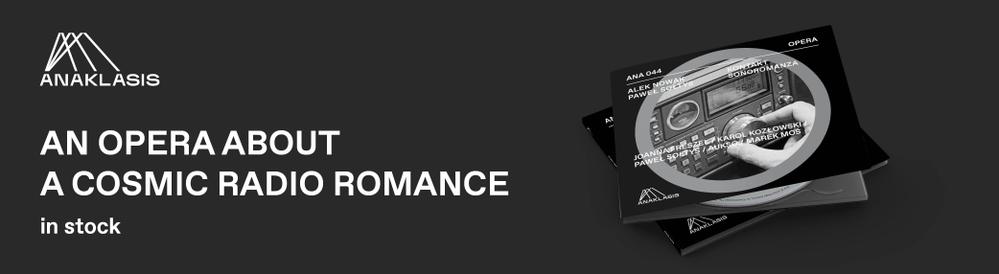
Contact. Sonoromanza is an opera by Alek Nowak and Paweł Sołtys’s literary debut in the world of classical music. A contemporary tale of longing, the desire for conversation and the need for closeness, performed by Joanna Freszel, Karol Kozłowski and the AUKSO Chamber Orchestra of the City of Tychy, conducted by Marek Mos. The debut album, ANAKLASIS, is now available to buy and on streaming services.
October will bring a series of world premieres of the latest compositions by artists represented byPWM Edition. New works by Zygmunt Krauze, Alek Nowak, Joanna Woźny, Ewa Fabiańska-Jelińska, Agata Zubel, Paweł Malinowski, Andrzej Kwieciński and Aleksander Lasoń will be performed in Poland, as well as in Japan, Germany and Austria.
On September 14, the prestigious Teatro Petruzzelli in Bari will host the Italian premiere of Zygmunt Krauze's two-act opera, which tells the poignant story of Bona Sforza d’Aragona. Staging this work in Bari carries deep symbolic meaning – it is the very city where the title heroine spent her final years and was laid to rest.
This autumn, with the September premieres of the latest Polish music, we are stepping forward neither boldly nor timidly – in keeping with Gdańsk’s motto. It is in this city that the first world premieres will take place. In September, we will be listening to new works by Polish composers in Gdańsk, Warsaw and Valencia. For the first time, we will hear works by Tadeusz Wielecki, Lidia Zielińska, Krzysztof Knittel and Agata Zubel.
Karol Augustyniak and Artur Szczepkowski have been selected as winners of the composer.pl programme – an artistic residency in Iceland for young Polish composers. The invited participants’ creative residency in the ‘Land of Ice and Fire’ will last two weeks, from 8 to 25 September.
Today, 2 December, marks the start of the 18th edition of one of Europe's most prestigious conducting competitions: the Donatella Flick – London Symphony Orchestra Conducting Competition. Grażyna Bacewicz's Concerto for String Orchestra is among the repertoire as an obligatory piece.
This timeless encounter with the music of ‘Poland’s last Romantic’ Tadeusz Baird and with the interpretative feats of NOSPR Polish National Radio Symphony Orchestra features three symphonies and four outstanding conductors in both rediscovered historical and new recordings, released together on a 2CD album from ANAKLASIS.
Iconic songs by Zygmunt Konieczny that audiences of Ewa Demarczyk loved decades ago in a new arrangement by Cezary Duchnowski. The latest ANAKLASIS album with Agata Zubel, Andrzej Bauer, Bartek Wąsik and the National Polish Radio Symphony Orchestra conducted by Alexander Humala is now available for purchase.
